Friday, May 11, 2012
Amrakhand
This is a small part of an e-mail I wrote 2 years ago, soon after I wrote this post, to a few of my very special childhood friends. We were a group of 3 girls and 2 boys and their friendship was one of the best things that ever happened to me.
Do you remember our summer holidays? The months of April and May when the sun shone with all its might and we roamed aimlessly around the neighbourhood, barefoot, with nary a care in the world.
Except, of course, our exam results.
Tell me, do you remember those little white lies we told each other of how well we had done in our exams, only to sheepishly hang our heads in shame when our mothers got together and bemoaned our dismal results?
Do you remember the games we used to play? I know how that sounds - games we played - but back then, it simply meant lagori, dabba ice-spice, chor police, dodge ball, carrom, statue or colour - colour, to name some. We could play all day long; in fact, the day isn't just long enough to accomodate all our games, we used to complain!
Of course, there were times when we would fight. Bitterly. Loudly. Physically. We would take sides, split into groups, and declare a cold war.....only to reconcile a few hours later, and start playing again, as if the fight had never happened. Playing, fighting, reconciling - it was all so easy then.
Do you remember us glugging down glasses of cold panha, kokum sherbet or Rasna after playing in the hot sun, and egging you M, to burp? Louder, louder, we used chant. And you would oblige us every single time.
We would all collapse into giggles. We would laugh so hard that we would get hiccups. So we'd drink some more juice to get rid of the hiccups, and start with the 'burp' game again.
Do you remember landing up at odd hours at each others' houses, demanding to be fed? With our mouths stuffed with food, and without any regard for the feelings of the aunty feeding us, we would start loud arguments about how our respective mom was the 'world's best cook'.
Do you remember the races we had? No, we never had running or cycling races. We competed to find who could eat a ripe mango the fastest. We would soften the mango between our fingers and suck on it, the juice dripping down on our already stained and muddy clothes. K, your 'white' petticoats would take quite a beating! We never savoured the taste then, all we wanted was to eat as fast as possible.
And, do you remember looking up at the skies towards the end of May when the monsoon clouds would start to gather? We couldn't wait to get wet in the first monsoon showers, and yet the first showers would always sadden us a little. For with the first showers also came the realisation that our schools would reopen soon, and we would have to wait a whole year for the fun to begin again.
"Oh what a vacation we 've had", we would say over and over again. "We are never going to forget it".
So tell me....tell me that you still remember. Because I....I have never forgotten.
*******************************************************************************
I have said this before and I don't mind saying it again. No matter where I live, no matter what the season it is there at that time, to me the months of April and May will forever mean summer holidays.
And mangoes. Lots of mangoes.

And amrakhand. We preferred amrakhand over shrikhand and when the mango season was at its peak, there would be amrakhand at the table almost every other day.

Amrakhand is simply mango pulp mixed together with chakka or hung curd and sweetened with a bit sugar. Making it is very easy but it does need some pre-preparation.
Making chakka or hung curd:
Chakka or hung curd is nothing but yogurt from which excess water has been drained off.

To make hung curd, you will need a muslin cloth and a bowl. Place the muslin cloth over the bowl and pour the yogurt in the centre of the muslin cloth. Tie up the muslin cloth tightly with a string and suspend it over a hook. ( I suspend mine over a door knob) and place the bowl directly under the cloth. This is important, else you will end up with a puddle of whey!
After about 4 hours, open the muslin cloth and gently mix the yogurt, tie it up tightly once again and suspend it for another 4 hours. At the end of about 8 hours, you should end up with a creamy yogurt, almost like cream cheese.
(Don't discard the water strained from the yogurt. You can use it in your curries or to knead dough; I use it to make dugh).
Once you have the thick and creamy hung curd, making amrakhand is a breeze.
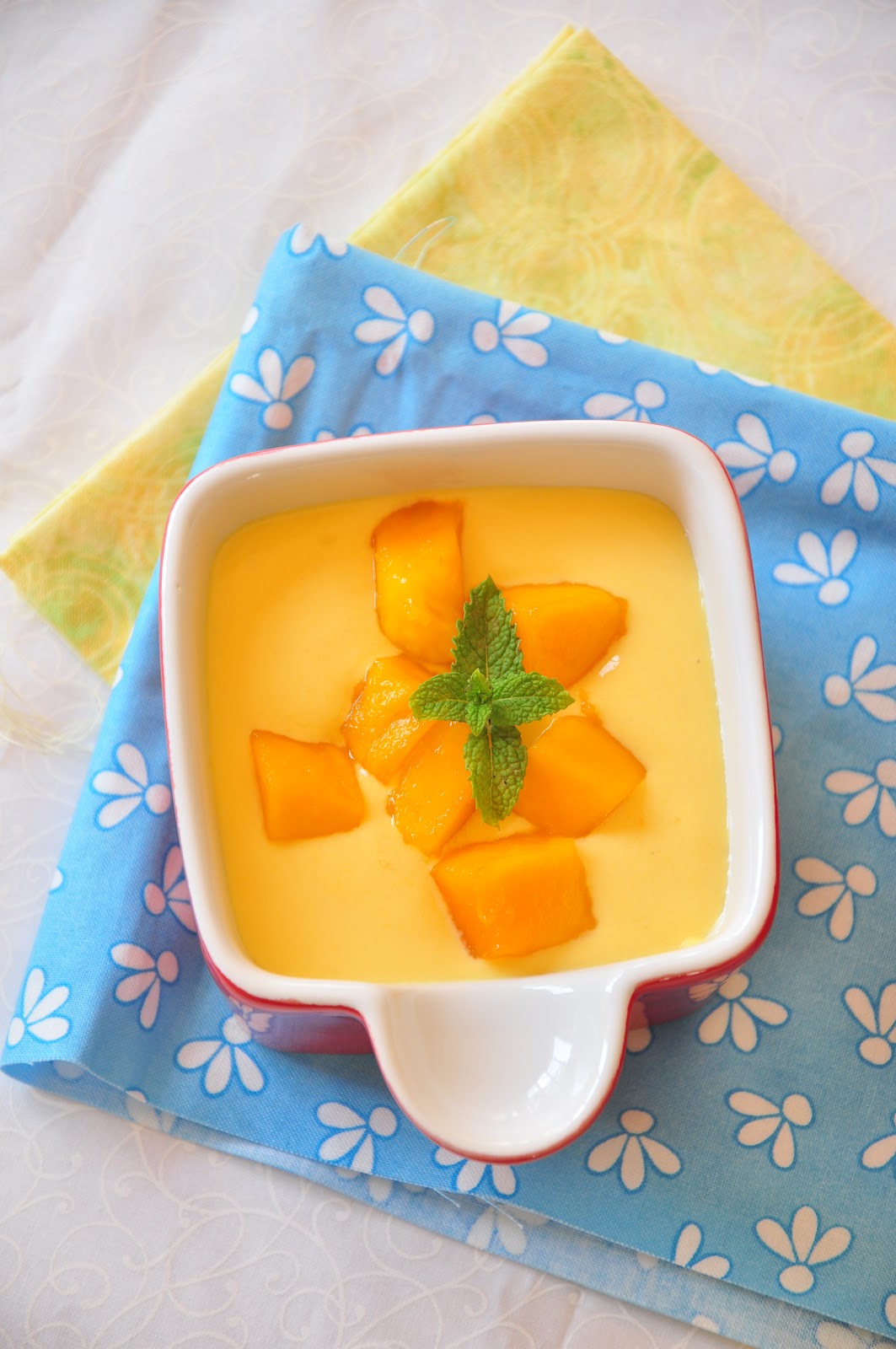
Amrakhand
Ingredients:
Hung curd: 2 cups
Fresh mango pulp: 1.5 cups - 2 cups ( see 'notes' below)
Cardamom powder: 3/4 tsp
Icing sugar: 2 tbsps, or to taste
Salt: a pinch
for garnishing, optional:
Chopped nuts: 2-3 tbsps
Mango cubes: 1/2 cup
Method:
Make mango pulp by pureeing mango cubes in a blender.
Place a sieve over a bowl, put the the hung curd and the mango pulp into the sieve and mix together with a spoon.

You could mix the two directly in a bowl, but passing it through the sieve ensures a smooth, lump - free, glossy amrakhand.
Add the cardamom powder and the salt. Do a taste test and add sugar as needed. I sometimes don't need to add any sugar, the sweetness from the mangoes is good enough for us.
Let it rest in the refrigerator for atleast a couple of hours before serving in order to allow the flavours to mingle.
Garnish with nuts and serve the traditional way, with hot puris.
Or, if frying puris is as tedious for you as it is for me, fold in a few mango cubes and serve it as a post meal dessert. Absolute manna from heaven!

Notes:
Canned mango pulp is very easy to get these days. It doesn't matter. Make amrakhand with fresh mangoes only. For nothing else can match the taste of fresh mangoes in amrakhand.
The colour of your amrakhand will depend on the type of mango used.
Use pulpy as opposed to juicy mangoes. In India, Alphonso mangoes work best. Here in Johannesburg, I used Heidi mangoes.
If I am serving the amrakhand with puris, I use 1.5 cups of mango pulp for 2 cups of hung curd in order to get a thicker amrakhand. I increase the mango pulp to 2 cups if I am serving it as a post meal dessert to get a more intense mango flavour.

Friday, January 20, 2012
Kelyachi Bhaji/ Ripe Banana Fritters
Aunty, obviously, had not had enough of catching up and invited me home. I had a very faint recollection of her being a fabulous cook and so, was in fact secretly glad that she had invited me over.
It was a lovely evening - there is something very entertaining in listening to the older generation reminisce about the days gone by, especially when such conversations are accompanied by delicious food and a steaming hot cup of tea. That evening, in addition to batata vada and khandvi, Aunty had made some delicious ripe banana pakoras. The taste was very familiar; my mom used to make something similar.
"These are delicious," I told her. "Mama used to make something similar."
"Not similar....your mom used to prepare exactly the same bhajis. In fact, I learnt it from her. I knew you liked these. Actually you know, when you were a child......" and she went on to recount some embarrassing account from my childhood as I continued to nibble, red-faced, on the delicious banana bhajis.

In my pursuit of making newer things like banana bread, I had forgotten about these bhajis. But I remember my mom making these
Kelyachi bhaji/ Ripe Banana Fritters
Ingredients:
Mashed over-ripe bananas: 1/3 cup
Whole wheat flour (atta)*: 2 tbsps - 3 tbsps
Jaggery: 2 tsps, grated
Cinnamon powder: 1/2 tsp OR cardamom powder: 1/4 tsp
Salt: a pinch
Oil for deep frying
* if you are using whole wheat pastry flour, grind it in your spice grinder to get a finer texture.
Method:
Add the jaggery, cinnamon powder and salt to the mashed bananas and mix well. Then add the flour, one tbsp at a time till your get a batter of dropping consistency.

Heat oil in a deep wok. When the oil is sufficiently hot, drop the heat to medium. Add a teaspoonful of batter and fry till the bhajis are evenly brown.
If you, like me, are averse to deep frying, you could also make these in a paniyaram pan.

Make the batter as above. Add a few drops of oil in each hole of the pan. When hot, fill with the batter.

Drizzle a few drops of oil around the sides, cover and cook for about 3-4 minutes. Using a chopstick, flip the bhajis and cook for another 3 minutes or until evenly brown.
Serve hot with a cup of steaming hot tea. Enjoy!
Friday, October 7, 2011
Semiya Payasam
Growing up, I used to call semiya (or vermicelli, as it is known in English) 'worms'. Take a look at the picture - the semiya strands do look like (dried) worms, don't they?

So, much to my mom's dismay, I would never touch anything made of semiya. It was only when I was well into my teens and was forced to have it, out of courtesy, at a friend's place that I grew out of my rather brattish attitude to semiya.

Today, of all the payasams that I make - coconut milk payasam, rice payasam - semiya payasam reigns as my favourite. A lot of it is, I think, to do with how easy and quick this payasam is to prepare. Toss the semiya in some ghee, simmer it milk, sweeten it, simmer some more and it is ready - in almost under 30 minutes.
It is no wonder then that semiya paysam features so often on my menu, especially on festive days.

Semiya Payasam
Ingredients:
Semiya/Vermicelli: 3/4 cup
Low Fat Milk: 2 cups
Low Fat Evaporated Milk: 1 tin/ 380 ml
Sugar: 1/2 cup (this amount works for us, adjust as per your taste buds)
Cardamom: 10 pods, crushed into a coarse powder
Assorted nuts (I use 1 tbsp each of almonds, cashewnuts and pistachios)
Ghee: 2 tbsps
Method:
Heat ghee in a wok and roast the vermicelli till it starts to change colour from translucent to white and brown. Keep tossing the vermicelli continuously around the wok, else it will burn.
Transfer the vermicelli into a colander and rinse it in warm water. This step is optional, but doing this will wash the ghee away and therefore, you won't have any ghee floating on top of the payasam.
In a deep, thick bottomed pan, mix together low fat milk and the evaporated milk and bring to a boil. Add the vermicelli to the milk. The uncooked vermicelli will sink to the bottom of the pan and so, give it a good stir occasionally till the vermicelli softens and cooks. Once cooked, the vermicelli will plump up.
After the vermicelli cooks, add sugar, chopped nuts and the cardamom powder and let the payasam simmer on low heat for about 15-20 minutes.
Garnish with chopped pistachios and serve hot. I personally prefer to let the payasam rest for at least a couple of hours in order to let the flavours mingle.
Of Chalks and Chopsticks: September was being hosted here; unfortunately, I haven't had any time to work on my story. So, for very selfish reasons, I am going to extend the deadline to October 31st. If you, like me, haven't worked on yours yet, do it now!
Monday, September 26, 2011
Gajar Halwa/ Indian Carrot Pudding
Pick any Bollywood movie of the 70s or 8os and in all probability, the script would have a long-suffering mother who has battled poverty and other evils and injustices to raise a son on whom she has pinned all her hopes. And whenever that prodigal/recalcitrant/obedient/law-abiding (choose any one – just take your pick) but dutiful and mother-worshipping (absolutely necessary and essential qualities) would return from his studies in a boarding school/ a spell in the jail/ deputation at work (again, take your pick), this long-suffering and sometimes ailing mother would make some ‘halwa’ for her beloved son.
So what is 'halwa'? Halwa is originally an Arabic word meaning a sweet confection. Typically, it is made of either flour or nuts or fruits or even vegetables cooked in copious amounts of butter or ghee and sweetened with either sugar, jaggery or honey.
From Argentina to Ukraine, different countries have their own versions of halwa; in India, the more popular ones are sooji ka halwa (semolina halwa), moong dal halwa, atte ka halwa (whole wheat flour halwa), doodhi halwa (bottle gourd halwa) and gajar halwa (carrot halwa).
Coming back to Bollywood movies and halwa, I don't recall any movie ever mentioning what halwa the mother cooked for her son but I had this firm belief that the said halwa was none other than gajar ka halwa.
Probably because gajar ka halwa was, and still is, my favourite halwa.

You need all of 6 ingredients to make gajar ka halwa: carrots, milk, sugar, ghee, raisins and cardamom powder.
Oh and I forgot to mention - you also need plenty of elbow grease. After all, the carrots need to be grated. Well, yes. You need grated carrots. No, there are no short-cuts(unless you have a food processor, of course).

Gajar Halwa/ Indian Style Carrot Pudding
Ingredients:
Grated carrots: 4 cups
Low fat evaporated milk: 2 cups
Fresh milk: ½ cup
Sugar: ½ cup (adjust the quantity as per your taste and the sweetness of the carrots. Normally, this amount works for us)
Raisins: 1 tbsp
Cardamom pods: 10, powdered
Ghee: 1/3 cup
Method:
Melt 2 tbsps of the ghee in a wok. Add in the carrots and sauté in the ghee till they start to change colour. Then, pour in the milk (both evaporated and fresh milk) and simmer the carrots in the milk, stirring occasionally, till the milk almost (but not completely) evaporates.
Add the sugar, cardamom powder and the raisins and stir constantly (at this stage, you need to continuously stir the halwa, else it will stick to the bottom of the pan) till all the liquid dries up and the halwa starts to come off the sides of the pan. Taste and adjust the sweetness as per your palate preference.
Finally, add the remaining ghee and stir briskly for a minute.

Garnish with slivered almonds or pistachios.
Most people like to have gajar ka halwa hot, but I love to have it chilled. Have it any which way you please, but remember, thinking of diets when digging into the halwa is absolutely forbidden!
Sending this to Raks who is hosting Nivedita's Celebrate Sweets: Sweets/Desserts with Fruits and Vegetables
Thursday, April 15, 2010
Coconut Milk Payasam
In the morning, much to her bewilderment, we covered her eyes and led her to view the vishukkani.
Just as my mother in law had led me for my first Vishu. It has been 6 years, but the memories of my first Vishu are fresh in my mind, as if it were yesterday.
“Vishu is our new year,” she explained, leading me into the puja room. “We believe that if the vishukkani is the first thing we see on this day, it brings good luck. I hope you will observe all our festivals when you return home,” she concluded.
"That's right. Try and learn as much as you can so you can continue our tradition," chorused the relatives. Relatives who had come from all over to meet Anand who was visiting India after 4 years. But more than Anand, they had come to see his wife. Me. Kate.
Their voices filled the air as they chatted loudly and excitedly. I basked in their love; I was happy to have found a family that had welcomed me with open arms. I did know of some who were not so accepting. In fact, soon after viewing the vishukkani, the family (and much to my dismay, Anand as well), would be off for a puja where I, a foreigner and a believer of a different religion, was not welcome.
"I am sorry Kate that you had to face this. But we really cannot snub them, after all mom and dad have to live here," Anand reasoned with me. One by one, they said apologetic goodbyes to me and left.
They would be back in the afternoon, but the silence in the enormous house was overwhelming. Sunlight streamed in through the slats of the windows and I sunk into a wooden armchair, soaking in the warmth of the sun and inhaling the aroma of the sandalwood and camphor that permeated through the house.
I must have dozed off for a bit; when I opened my eyes, I was shocked to see an old woman sitting in front of me, staring and smiling, rather fondly, at me. But then I reasoned that she must be one of the many servants that worked around here and smiled back at her. The rays of the sun fell on her face and illuminated it in a soft glow; her face certainly looked very familiar though I couldn't quite place her.
Seeing me awake, she got me a cup of coffee and started talking to me. She knew I couldn’t understand a word of what she was saying; likewise even I knew that she couldn’t follow me, but I was glad for her company in this empty house.
The clock chimed 10 O’clock and I realised that through gestures, we had been having a conversation of sorts for about an hour! The old lady looked at the time and motioned me to get up and follow her into the kitchen. Obviously, she wanted me to do something. “Watch and learn,” she seemed to say.
She cracked open a couple of coconuts and started scraping them. She was old and her movements were slow, but her hands steady as she worked on the scrapings to extract some coconut milk. When she mixed the thinnest of the coconut milk with some uncooked rice, I realised she was making – or rather, teaching me to make payasam, a sweet not quite unlike rice pudding. You see Anand had been tutoring me on the basics of Tamil cuisine for quite a while!
By the time the payasam was done, I was ravenous. She quickly made some dosas –thin rice crepes - for me. As I ate, she came and stood beside me. Her eyes were kind and full of love; occasionally, she would run her hand over my head.
It was past noon and I was tired. It was the heat that sapped me out even though I had done nothing since morning. Making my apologies to this old lady, I headed to the bedroom for a siesta.
I woke just up just as the family returned. “I see you made some coconut milk payasam,” beamed Anand as he fondly spooned it into bowls for everyone.
I felt almost like a child as I waited expectantly for their reaction but nothing could’ve prepared me for it. No sooner had they had the first spoonful, an excited chatter ensued. I understood nothing of it, but realised it had to do with the payasam. Tentatively, I tasted it – it was fantastic.
“Honey, it seems you accidentally put in cloves instead of cardamoms in the payasam,” said Anand.
"Is that what all this talk is all about? But no, I didn't put them in by mistake. The old lady who came in to work this morning told me to,” I replied.
Suddenly, the talk died down. “Kate, who are you talking about? What old woman? The only one who was supposed to come in today was Radha. The one who showed you to make kolam the other say,” said my MIL.
"Well, it wasn't Radha, but an old woman who came in the morning. Wonder where she is now."
“Maybe Radha sent in someone else in her place. Happens all the time,” said my FIL.
“What’s this (fuss) all about?” I wondered aloud.
“Oh honey, it is just those cloves in the payasam. Grandma – my mum’s mum – was rather fond of cloves. Always had a small pouch tucked into her sari. She was the only one who used cloves in payasam. This payasam you made tastes exactly like hers."
He continued, "Pity she didn't live long enough to meet you. She would have doted on you. Come, let me show you her pictures."
The sun was now setting and as we flipped the pages of the albums, the final rays of the sun streamed in and fell on Anand’s face and illuminated it in a soft glow. With a chill, I realised why the old lady had looked so familiar. “There she is, this is my grandma,” he said.
But I didn’t quite need to see her pictures for I had already met Anand's dead grandma that morning.
Six years have gone by but in all honesty, not a day goes by when I don't recall that strange encounter. And yes, every Vishu, I make the coconut milk payasam exactly the way she had taught me.
Completely fictional, this is my entry for Of Chalks and Chopsticks that I am hosting this month.

Coconut Milk Payasam
Ingredients:
Rice: 1/2 cup
Coconut milk: 500 ml
Palm Jaggery*: 80- 100 gms
Ghee: 1 tbsp
Cloves: 6 nos
Green Cardamom: 2 nos
Nutmeg, optional: a pinch
Salt: a pinch
Dates/raisins and sliced almonds: to your taste (I use 2 tbsps of sliced dates and 1 tbsp of chopped almonds)
Method:
Wash and soak the rice for 30 mins.
In a wok, heat the ghee and add the cloves and the green cardamom. Stir for a minute.
Drain the rice and add it into the wok, stir till the grains are coated with the ghee. Add in 1 cup of water and 3/4 cup of coconut milk. Cook the rice till it turns soft and mushy; I pressure cook the rice for 5 whistles.
In the meantime, add a couple of tbsps of water to the jaggery and melt it.
Strain the melted jaggery and add it to the cooked rice. Pour in the remaining coconut milk, nutmeg, salt and the dates and almonds, if using. Bring to a boil and simmer a further 2 mins on a very low flame.
Allow to rest a couple of hours before serving, the flavours in this payasam really develop after a couple of hours.
Notes:
Coconut milk spoils very easily, especially in tropical climates. As soon as the payasam cools down to room temperature, transfer it in the fridge.
If you find that the payasam is getting too thick, add in about 75 ml of plain milk.
The sweetness of jaggery keeps varying. So the amount of jaggery in this recipe is only a guideline, do a taste test to ascertain the amount of jaggery you need.
I use palm jaggery which has a lovely nutty taste, the original recipe uses cane jaggery.
Monday, March 16, 2009
Kheer/Payasam
And so call it payasam or kheer or payesh or even rice pudding, it is something that has universal appeal. Creamy in texture with the delicate flavour of nuts and cardamom and the sudden burst of flavour of the plumped up raisins, rice kheer is the perfect answer to a no - sweat, easy to make dessert.

Monday, January 26, 2009
Kesar Pista Kulfi - Decadent Cool Fix
What's this, they asked (it was mixed nationality group of guests we had) when we served the dessert.
Kulfi, we said.
Cool fay? Cool fix?
No, Kulfi. Coolfee. Indian ice cream, we said, by way of explanation.
Though, technically, kulfi is not ice cream. It is a distinct category of its own alongside sorbets, granitas, gelatos, frozen yoghurts etc.
Kulfi is believed to owe its origins to the Mughals. Blocks of ice would be brought in to Delhi from the Hindukush mountains in order to keep the royalty cool in the searing hot Delhi summers. Mughal chefs, having ice at their disposal and taking a cue from their Persian and Arabic counterparts (incidentally, ice cream traces its origins back to Persia where the royalty was served a special chilled pudding like dish with vermicelli and rosewater), later invented 'kulfi'.
From being once reserved exclusively for royalty, kulfi is now a street food in India sold by hawkers called kulfiwallahs. They sell the kulfi either in small earthern pots called matkas or in aluminium popsicle like molds. The molds are buried in a huge metal container holding a mixture of ice and salt - this effectively freezes the kulfi. Bearing a huge cane basket, in which they secure the metal container in a distinct red cloth, on top of their heads, you'll find them going from street to street enticing the taste buds with their loud cries of "kulfeeeee" on balmy summer nights!
Normally, kulfi is made by sweating over a the gas to painstakingly reduce the milk to almost half. However, I do not have the energy or the patience to do that. The memory of trying to make malai pedhas is fresh in my mind - reduce the milk, said the recipe till it becomes a solid mass. Yeah, right....I got all of 7 pedhas after over an hour of toiling and sweating!! Which is why I knew I had struck gold with this recipe. No boiling. No cooking. Just mix and freeze.

Ingredients:
for the base
1 can evaporated milk
1 can condensed milk
300 ml cream
breadcrumbs from 1 slice of bread
Traditionally, kulfi has been flavoured with cardamom, saffron and nuts, though today, a myriad of flavours abound, most popular being mango, custard apple, chikoo...and yes, even chocolate! I decided to stick to the traditional flavour of cardamom, pistachio and saffron.
for the flavouring:
10-12 pods of cardamom, peeled
1/2 cup pistachio, shelled
saffron, about 10-12 strands
rosewater - 1 tsp
Method:
Soak the saffron in the rosewater for about 10 mins. Grind the pistachio and the cardamom to a fine powder. Mix with the remaining ingredients for the kulfi base and process in a mixie. Now, stir in the soaked saffron. Pour into molds of your choice and freeze.
I set my kulfi in a 10" cake pan. To facilitate unmolding, just dab some butter in the centre of the pan and line with butter paper. Pour the kulfi mixture and freeze it. Before serving, run a knife dipped in hot water along the edge of the pan. Tip over your serving plate, rub the base vigorously with a kitchen towel, remove pan and peel off the butter paper. Cut and serve.
Makes enough to serve between 8-12 people, depending on the size of the slices.
Yes, it is high in calories. But, one bite and your guests will ask you for more, calories be damned. One bite, and you'll want to keep the whole thing for yourself, calories and guests be damned!!


