Thursday, August 23, 2012
French Yogurt Cake - where baking is child's play
One moment, you are nagging urging your toddler to get more independent, the next moment you are left wondering when exactly was that moment when he/she grew up so much...motherhood is a long journey speckled with such tales.
This is one such story. One that left me awe-struck and proud that my daughter, who refuses to fix herself a bowl of cereal, could independently bake a cake.
My daughter, like me, loves the process of baking. Her eyes fill with wonder as she sees the ingredients added in, one after another, to make a batter that then rises to make a cake or bread, the aroma enveloping the entire house. "Wow, look at that', she exclaims when she sees the final product pulled out of the oven. I bake a lot with her just so I can rejoice with her in her sense of wonder. She has been my most trusted little helper in the kitchen, mixing in the ingredients as I measure them out.
One day, during her 2 month long vacation, she decided she wanted to bake a cake all by herself. She wanted to follow a recipe, she said, and bake a cake. Without any help from me. I was skeptical, she was determined.
We tried a couple of recipes, ones that didn't involve any creaming of butter and sugar, but she would get hassled at the use of multiple measuring cups... 1 1/3 cup of sugar, 2/3 cups of water, 2/3 cups + 2tbsps of oil...you get the picture. Clearly, we needed a recipe that made measuring the ingredients...well, child's play.
Looking up child friendly baking recipes on Google led me to the French Yogurt Cake. Apparently, the French Yogurt Cake is one that French kids learn to bake at a very young age because it is so easy to make.
Type French Yogurt Cake into your search engine and you will be flooded with recipes. I wanted one with a yogurt pot measure and ended up using this recipe as a guideline.

FRENCH YOGURT CAKE
Ingredients:
A bored toddler
A mom willing to clean up after the toddler is done messing up the kitchen baking
Full fat yogurt*: 1 pot (mine was 100gms)
Sugar: 2 pots, around 205 gms
All purpose flour: 3 pots, 220 gms
Eggs: 2 nos, or 100 gms
Oil: 3/4 pot
Baking powder: 1 1/2 tsp
Vanilla essence: 1 tsp
Salt: 1/4 tsp
Zest of a lime, optional
*You can use a yogurt pot of any volume...100 gms, 125 gms, 150 gms. Given the 1:2:3 ratio of yogurt, sugar, and flour, the quantity of sugar and flour will proportionately increase. Ensure that the weight of the eggs is equal to that of the yogurt. Also, you will need to increase the baking powder; for this cake, you will need to use 3/4 tsp per 50 gm egg.
Method:
Sieve together the flour, salt and baking powder 3 times.
Lightly beat the eggs with a fork. Add the sugar to the eggs and mix it in. To this, add the yogurt and the vanilla essence.
Next, pour the oil in a thin stream.
Finally, fold in the flour in 3 quick additions. Add the lime zest, if using.
Grease and line a 8" cake pan or a loaf pan and bake at 180 deg C or 350 deg F for about 30-35 mins, or until a skewer inserted in the centre of the cake comes out clean.
(I draw the line at measuring the ingredients, making the batter and pouring it into the pan. When it is time to handle the oven, I make sure that I am around).

This is delightfully soft cake and is perfect with a cup of tea or coffee. I savour every bite, not because it is a nice cake, but because of the little hands that make it! Try making this with your toddler and revel in their sense of accomplishment. Worth every single crumb, I promise.
This is one such story. One that left me awe-struck and proud that my daughter, who refuses to fix herself a bowl of cereal, could independently bake a cake.
My daughter, like me, loves the process of baking. Her eyes fill with wonder as she sees the ingredients added in, one after another, to make a batter that then rises to make a cake or bread, the aroma enveloping the entire house. "Wow, look at that', she exclaims when she sees the final product pulled out of the oven. I bake a lot with her just so I can rejoice with her in her sense of wonder. She has been my most trusted little helper in the kitchen, mixing in the ingredients as I measure them out.
One day, during her 2 month long vacation, she decided she wanted to bake a cake all by herself. She wanted to follow a recipe, she said, and bake a cake. Without any help from me. I was skeptical, she was determined.
We tried a couple of recipes, ones that didn't involve any creaming of butter and sugar, but she would get hassled at the use of multiple measuring cups... 1 1/3 cup of sugar, 2/3 cups of water, 2/3 cups + 2tbsps of oil...you get the picture. Clearly, we needed a recipe that made measuring the ingredients...well, child's play.
Looking up child friendly baking recipes on Google led me to the French Yogurt Cake. Apparently, the French Yogurt Cake is one that French kids learn to bake at a very young age because it is so easy to make.
Type French Yogurt Cake into your search engine and you will be flooded with recipes. I wanted one with a yogurt pot measure and ended up using this recipe as a guideline.

FRENCH YOGURT CAKE
Ingredients:
A bored toddler
A mom willing to clean up after the toddler is done
Full fat yogurt*: 1 pot (mine was 100gms)
Sugar: 2 pots, around 205 gms
All purpose flour: 3 pots, 220 gms
Eggs: 2 nos, or 100 gms
Oil: 3/4 pot
Baking powder: 1 1/2 tsp
Vanilla essence: 1 tsp
Salt: 1/4 tsp
Zest of a lime, optional
*You can use a yogurt pot of any volume...100 gms, 125 gms, 150 gms. Given the 1:2:3 ratio of yogurt, sugar, and flour, the quantity of sugar and flour will proportionately increase. Ensure that the weight of the eggs is equal to that of the yogurt. Also, you will need to increase the baking powder; for this cake, you will need to use 3/4 tsp per 50 gm egg.
Method:
Sieve together the flour, salt and baking powder 3 times.
Lightly beat the eggs with a fork. Add the sugar to the eggs and mix it in. To this, add the yogurt and the vanilla essence.
Next, pour the oil in a thin stream.
Finally, fold in the flour in 3 quick additions. Add the lime zest, if using.
Grease and line a 8" cake pan or a loaf pan and bake at 180 deg C or 350 deg F for about 30-35 mins, or until a skewer inserted in the centre of the cake comes out clean.
(I draw the line at measuring the ingredients, making the batter and pouring it into the pan. When it is time to handle the oven, I make sure that I am around).

This is delightfully soft cake and is perfect with a cup of tea or coffee. I savour every bite, not because it is a nice cake, but because of the little hands that make it! Try making this with your toddler and revel in their sense of accomplishment. Worth every single crumb, I promise.

Monday, August 13, 2012
Tres Leches Cake
I am, by nature, a procrastinator. My parents had nicknamed me 'the Queen of all things last minute'. It is not hard to see why. When in school, the homework would be done early in the morning between large gulps of milk, in college, projects would be finished by burning the proverbial midnight oil. Even today, I tend to fill out forms minutes before they need to be actually submitted. If you need any further proof of just how I tend to procrastinate, check out my entries to various food blog events...most of them are after the submission date.
When it comes to making desserts, however, I am the exact opposite. I will usually start making desserts soon after I have read the recipes - before I have even ascertained that I have all the ingredients that a recipe calls for.
So, why it took me almost 5 years to make the Tres Leches Cake is beyond me.
I first heard of, or rather read about, the Tres Leches Cake when I was looking up recipes for the Dulce de Leche flan. 'Pastel de Tres Leches' appeared as a related recipe on one of the many sites I visited.
I was intrigued by the Tres Leches Cake. The entire concept of mixing together and pouring a combination of 3 types of milk, and hence the name which translated means 3 milks cake, (condensed milk, evaporated milk and fresh cream) over a sponge cake fascinated me. Ever since I read about the cake, I made it many times....in my head. Sometimes, I would top the cake with mangoes. Other times, it would be peaches or lychees.
But I always stopped short of actually making the cake. I think it was fear that the milk mixture, devoid of any flavouring, would make the cake taste and smell very milky.
A couple of weeks ago, I came across a recipe that recommended using buttermilk. I loved the idea of using buttermilk, the tang from the buttermilk would be perfect to counter the 'milkiness' of condensed milk and evaporated milk.
I wasted no more time in making the Tres Leches Cake.

Tres Leches Cake
for the cake (recipe from the Pioneer Woman)
Eggs: 5, separated (mine weighed 51 gms)
Sugar: 1 cup
Milk: 1/3 cup
Vanilla essence: 1 1/2 tsp
All purpose flour: 1 cup
Cornflour: 1 tbsp
Baking powder : 1 1/2 tsp
Salt: 1/4 tsp
Oil: 1 tbsp
Method:
Sift together the flour, cornflour, baking powder and salt.
Whip the egg whites till you get soft peaks. Add 1/4 cup of sugar and whip till you get stiff peaks and set aside.
Beat together the egg yolks and the remaining 3/4 cup sugar till pale and creamy; the mixture should fall in ribbons when the beaters are lifted from the mixture.
Add the milk and vanilla essence.
Next, fold in the flour with a spatula till just combined.
Fold in the egg whites in 3 batches, and then add the oil and mix.
Pre-heat the oven to 350 deg F or 180 deg C. Grease and line a 10" round cake pan (I used a 9" cake pan, but on hindsight, I feel a 10" cake pan will be better; the original recipe uses a 9" x 13" pan).
Bake for 30-35 mins, or until a skewer inserted comes out clean. Cool the cake and then poke it all over right down to the bottom of the cake (at 1/2" intervals) with the skewer.
for the soaking liquid (adapted from Un Dejeuner de Soleil):
Evaporated milk: 1 1/2 cup
Condensed milk: 1 1/4 cup
Buttermilk: 3/4 cup
Brandy: 1 1/2 tbsps, optional
Vanilla pod: 1 small, or vanilla essence: 1 tsp
Method:
Slit the vanilla pod length-wise and scrape the seeds. Add the pod and the seeds to the evaporated milk and heat it till bubbles start to form around the edges of the evaporated milk. Cool and then add the condensed milk, buttermilk and brandy, if using.
Return the cake to the cake pan - I used a 9 1/2" springform pan, which made it easy for me to later transfer the cake on the cake platter - and slowly pour the milk over the cake starting at the edges and moving to the centre. I poured the milk in 3 batches, at an interval of 5 minutes between each addition.
Cover with clingfilm and refrigerate for at least 3-4 hours in order to allow the cake to absorb all the liquid.
for the topping:
Whipping cream: 300 ml
Icing sugar: to taste
Vanilla essence: 1/2 tsp
Frozen mixed berries: 450 gms
Sugar: 1/2 cup
Lemon juice: 1 tbsp
Cornflour: 2 tbsp mixed in a little water
Whip the cream with the icing sugar and essence till you get soft peaks.
Mix together the berries with the sugar and lemon juice and set aside for 30 minutes. Then, cook over a low heat till the berries soften and the juices start bubbling. Add the cornflour and stir continuously till the sauce thickens. Cool to room temperature.
Transfer the cake on a serving dish and spread the whipped cream over the top and sides of the cake and spoon the berry coulis over the top.

I made the Tres Leches Cake for a dinner party and it was devoured. Yes, devoured. There is no other word for it. This is all I was left with the next day; I barely manage to get a decent slice for a picture.
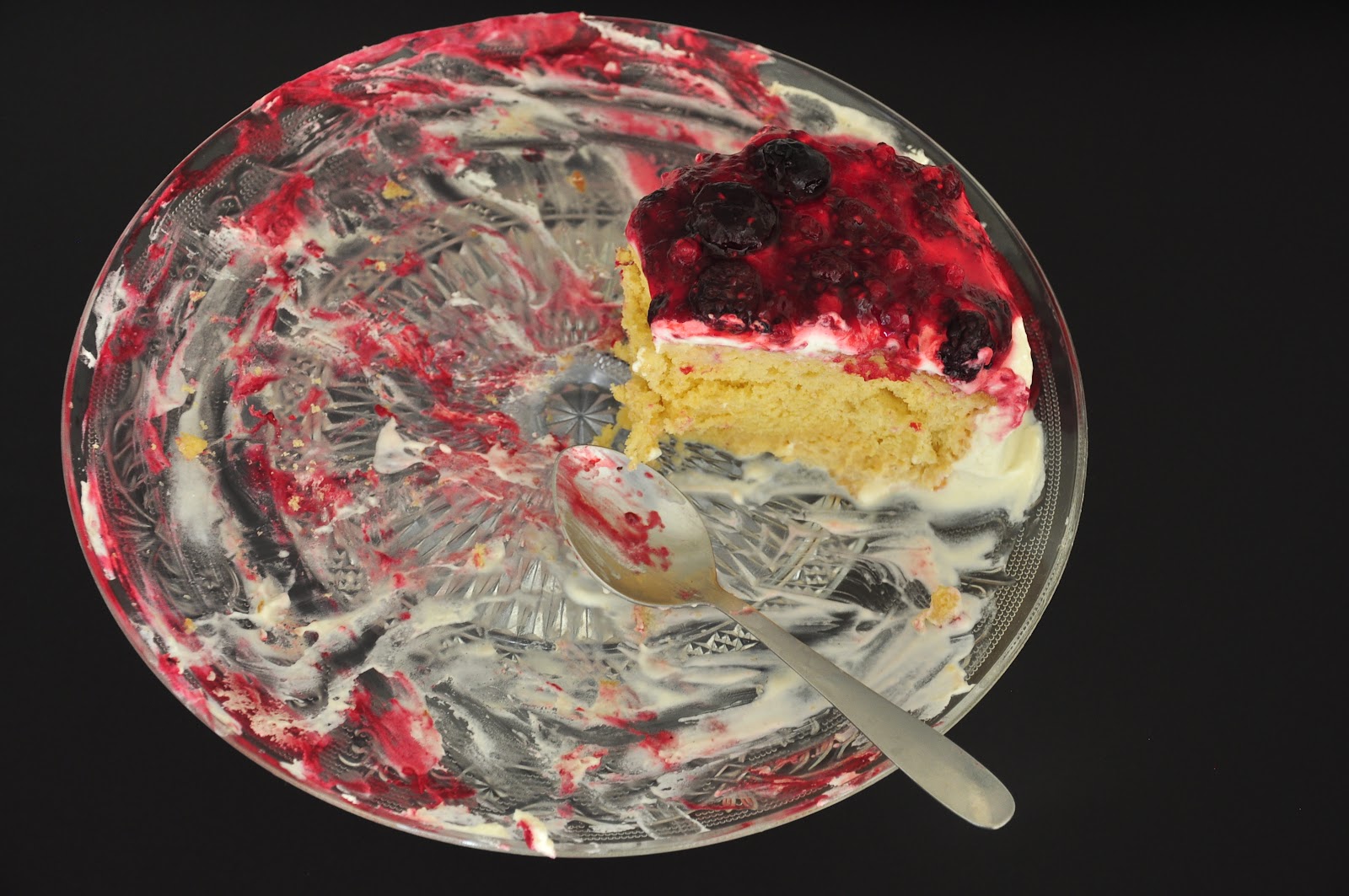
So, how is the cake, you ask.
To tell you the truth, in spite of all the praises heaped on the Tres Leches Cake, I made it with a bit of skepticism. I kept wondering if the soaking liquid would drown the cake and make it soggy, but I was wrong. It is amazing how the soaking liquid does not drench the cake. The cake stays firm, each slice retains its shape and yet each bite is very moist. The buttermilk gives it a slight tang, almost indiscernible, but still very much there. And then there is the whipped cream with the berry coulis...an explosion of flavours and texture in every bite.
I loved it so much that I can't wait to bake it again.
Oh, and in case if you are wondering what to do with the leftover evaporated milk, cream and condensed milk, make this kulfi which needs exactly the same ingredients.
Clearly, on some days, you can end up with a lot of dessert!
Tuesday, August 7, 2012
Glühwein
Most days begin like all other days. They slide through the same motions. Most of the times, they end the same way as any other day.
Routine. That is the word used to describe such days.
But sometimes, just sometimes, a day that begins like most others has something special in store, a magic that slowly unfolds as the minutes tick.
Today was one such special, magical day.
Today, it snowed in Johannesburg.

It was something really special, because snowfall in Joburg is rare. To put it in perspective, it has snowed all of 22 days in the last 103 years!

But what made the day absolutely magical was the fact that I was seeing snowfall for the first time in my life! The daughter and I frolicked outside, sticking our tongues out to taste the snow and dancing till our noses turned cold and numb.

To keep warm, I made some hot chocolate for her and Glühwein for me. Ok, not all of it for me, I was nice and shared it with some friends who dropped in.
I wanted to use Manisha's recipe but unfortunately, I was unable to access her blog today. So, I turned to Google (who else!) and adapted this recipe and another one that my friend Jess had emailed to make my Glühwein.

Ingredients:
Red wine: 1 litre (any red wine will do, I used a Merlot)*
Zest of 3 oranges and 1 lemon
Orange juice: 350 ml
Cinnamon quill: 2 nos
Cloves: 8
Star Anise: 1
Peppercorn: 10 nos
Sugar: 1/2 cup
Brandy: 1/2 cup, or less.
*Most recipes will recommend using a cheaper wine, but according to Jess, the cheaper the wine, the more sugar you need. Don't pull out your best wine, but the wine should be drinkable.
Method:
Combine all the ingredients in a saucepan, except the brandy, and heat gently for about 20 minutes without allowing the mixture come to a boil.
Turn off the heat, cover and allow all the flavours to infuse, about 30 minutes.
Strain, re-heat, add the brandy and serve.

Just as the Glühwein was ready to sip, it began snowing in earnest. Obviously, I had to first freeze my fingers and take some pictures.

Perfect day to enjoy the Glühwein. You do agree, don't you?
Routine. That is the word used to describe such days.
But sometimes, just sometimes, a day that begins like most others has something special in store, a magic that slowly unfolds as the minutes tick.
Today was one such special, magical day.
Today, it snowed in Johannesburg.

It was something really special, because snowfall in Joburg is rare. To put it in perspective, it has snowed all of 22 days in the last 103 years!

But what made the day absolutely magical was the fact that I was seeing snowfall for the first time in my life! The daughter and I frolicked outside, sticking our tongues out to taste the snow and dancing till our noses turned cold and numb.

To keep warm, I made some hot chocolate for her and Glühwein for me. Ok, not all of it for me, I was nice and shared it with some friends who dropped in.
I wanted to use Manisha's recipe but unfortunately, I was unable to access her blog today. So, I turned to Google (who else!) and adapted this recipe and another one that my friend Jess had emailed to make my Glühwein.

Ingredients:
Red wine: 1 litre (any red wine will do, I used a Merlot)*
Zest of 3 oranges and 1 lemon
Orange juice: 350 ml
Cinnamon quill: 2 nos
Cloves: 8
Star Anise: 1
Peppercorn: 10 nos
Sugar: 1/2 cup
Brandy: 1/2 cup, or less.
*Most recipes will recommend using a cheaper wine, but according to Jess, the cheaper the wine, the more sugar you need. Don't pull out your best wine, but the wine should be drinkable.
Method:
Combine all the ingredients in a saucepan, except the brandy, and heat gently for about 20 minutes without allowing the mixture come to a boil.
Turn off the heat, cover and allow all the flavours to infuse, about 30 minutes.
Strain, re-heat, add the brandy and serve.

Just as the Glühwein was ready to sip, it began snowing in earnest. Obviously, I had to first freeze my fingers and take some pictures.

Perfect day to enjoy the Glühwein. You do agree, don't you?
Friday, May 11, 2012
Amrakhand
This is a small part of an e-mail I wrote 2 years ago, soon after I wrote this post, to a few of my very special childhood friends. We were a group of 3 girls and 2 boys and their friendship was one of the best things that ever happened to me.
Do you remember our summer holidays? The months of April and May when the sun shone with all its might and we roamed aimlessly around the neighbourhood, barefoot, with nary a care in the world.
Except, of course, our exam results.
Tell me, do you remember those little white lies we told each other of how well we had done in our exams, only to sheepishly hang our heads in shame when our mothers got together and bemoaned our dismal results?
Do you remember the games we used to play? I know how that sounds - games we played - but back then, it simply meant lagori, dabba ice-spice, chor police, dodge ball, carrom, statue or colour - colour, to name some. We could play all day long; in fact, the day isn't just long enough to accomodate all our games, we used to complain!
Of course, there were times when we would fight. Bitterly. Loudly. Physically. We would take sides, split into groups, and declare a cold war.....only to reconcile a few hours later, and start playing again, as if the fight had never happened. Playing, fighting, reconciling - it was all so easy then.
Do you remember us glugging down glasses of cold panha, kokum sherbet or Rasna after playing in the hot sun, and egging you M, to burp? Louder, louder, we used chant. And you would oblige us every single time.
We would all collapse into giggles. We would laugh so hard that we would get hiccups. So we'd drink some more juice to get rid of the hiccups, and start with the 'burp' game again.
Do you remember landing up at odd hours at each others' houses, demanding to be fed? With our mouths stuffed with food, and without any regard for the feelings of the aunty feeding us, we would start loud arguments about how our respective mom was the 'world's best cook'.
Do you remember the races we had? No, we never had running or cycling races. We competed to find who could eat a ripe mango the fastest. We would soften the mango between our fingers and suck on it, the juice dripping down on our already stained and muddy clothes. K, your 'white' petticoats would take quite a beating! We never savoured the taste then, all we wanted was to eat as fast as possible.
And, do you remember looking up at the skies towards the end of May when the monsoon clouds would start to gather? We couldn't wait to get wet in the first monsoon showers, and yet the first showers would always sadden us a little. For with the first showers also came the realisation that our schools would reopen soon, and we would have to wait a whole year for the fun to begin again.
"Oh what a vacation we 've had", we would say over and over again. "We are never going to forget it".
So tell me....tell me that you still remember. Because I....I have never forgotten.
*******************************************************************************
I have said this before and I don't mind saying it again. No matter where I live, no matter what the season it is there at that time, to me the months of April and May will forever mean summer holidays.
And mangoes. Lots of mangoes.

And amrakhand. We preferred amrakhand over shrikhand and when the mango season was at its peak, there would be amrakhand at the table almost every other day.

Amrakhand is simply mango pulp mixed together with chakka or hung curd and sweetened with a bit sugar. Making it is very easy but it does need some pre-preparation.
Making chakka or hung curd:
Chakka or hung curd is nothing but yogurt from which excess water has been drained off.

To make hung curd, you will need a muslin cloth and a bowl. Place the muslin cloth over the bowl and pour the yogurt in the centre of the muslin cloth. Tie up the muslin cloth tightly with a string and suspend it over a hook. ( I suspend mine over a door knob) and place the bowl directly under the cloth. This is important, else you will end up with a puddle of whey!
After about 4 hours, open the muslin cloth and gently mix the yogurt, tie it up tightly once again and suspend it for another 4 hours. At the end of about 8 hours, you should end up with a creamy yogurt, almost like cream cheese.
(Don't discard the water strained from the yogurt. You can use it in your curries or to knead dough; I use it to make dugh).
Once you have the thick and creamy hung curd, making amrakhand is a breeze.
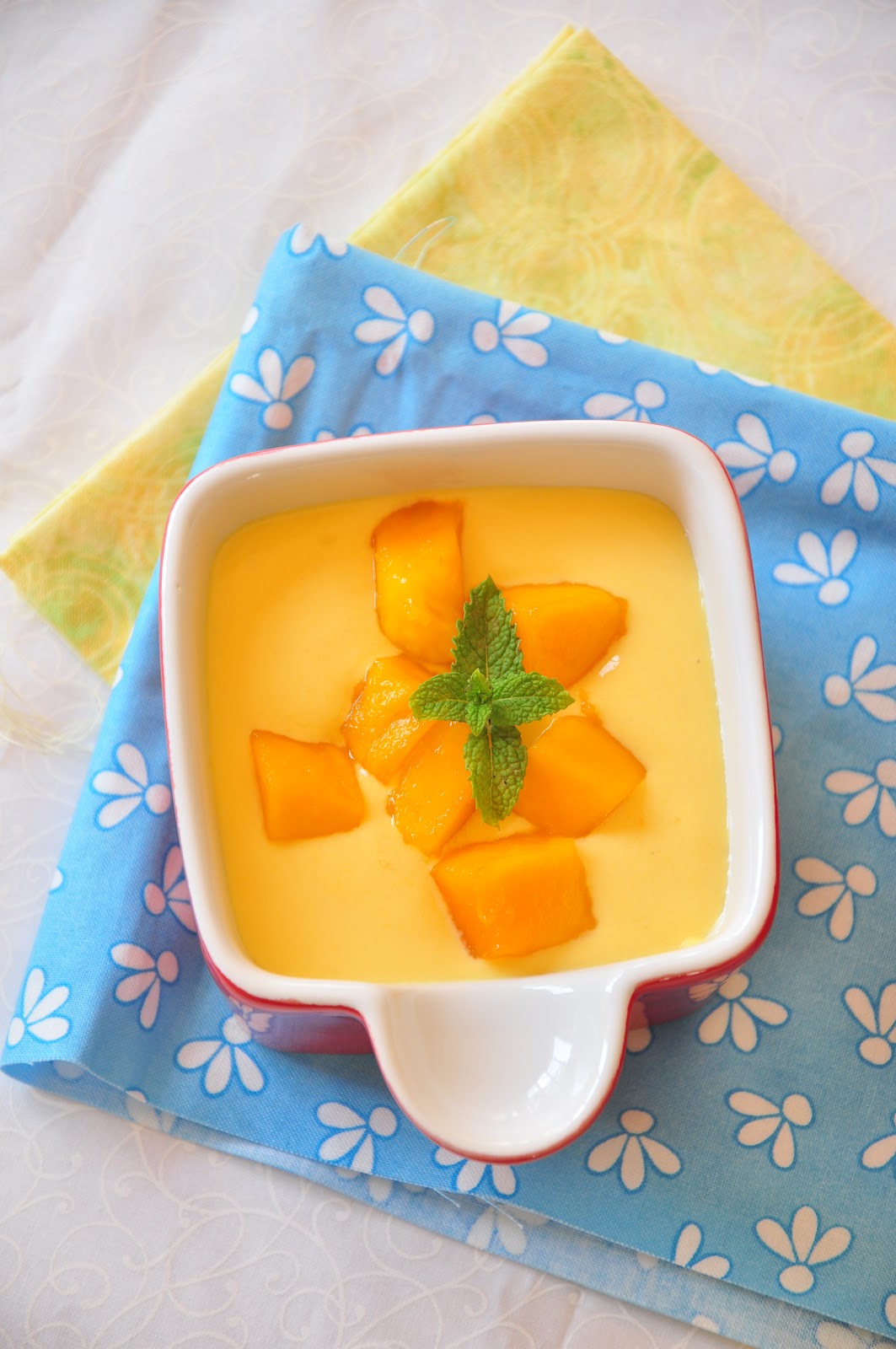
Amrakhand
Ingredients:
Hung curd: 2 cups
Fresh mango pulp: 1.5 cups - 2 cups ( see 'notes' below)
Cardamom powder: 3/4 tsp
Icing sugar: 2 tbsps, or to taste
Salt: a pinch
for garnishing, optional:
Chopped nuts: 2-3 tbsps
Mango cubes: 1/2 cup
Method:
Make mango pulp by pureeing mango cubes in a blender.
Place a sieve over a bowl, put the the hung curd and the mango pulp into the sieve and mix together with a spoon.

You could mix the two directly in a bowl, but passing it through the sieve ensures a smooth, lump - free, glossy amrakhand.
Add the cardamom powder and the salt. Do a taste test and add sugar as needed. I sometimes don't need to add any sugar, the sweetness from the mangoes is good enough for us.
Let it rest in the refrigerator for atleast a couple of hours before serving in order to allow the flavours to mingle.
Garnish with nuts and serve the traditional way, with hot puris.
Or, if frying puris is as tedious for you as it is for me, fold in a few mango cubes and serve it as a post meal dessert. Absolute manna from heaven!

Notes:
Canned mango pulp is very easy to get these days. It doesn't matter. Make amrakhand with fresh mangoes only. For nothing else can match the taste of fresh mangoes in amrakhand.
The colour of your amrakhand will depend on the type of mango used.
Use pulpy as opposed to juicy mangoes. In India, Alphonso mangoes work best. Here in Johannesburg, I used Heidi mangoes.
If I am serving the amrakhand with puris, I use 1.5 cups of mango pulp for 2 cups of hung curd in order to get a thicker amrakhand. I increase the mango pulp to 2 cups if I am serving it as a post meal dessert to get a more intense mango flavour.
Wednesday, April 25, 2012
Black Pepper Noodles with Stir Fried Vegetables
It was late morning on a lazy Sunday. The sun shone high up in the sky and the garden had burst into a myriad of colours. Under the clear blue skies, the scent of flowers hung heavy in the air and the bees buzzed noisily. High up on the branches of a tree whose name I don't know, the weaver birds worked furiously to build their nests.


It was the kind of day that made me want to do nothing but bask in the warm sun and feel the gentle breeze ruffling through my hair. It was the kind of day that made me want to lie down on a hammock (which, unfortunately, we don't have) and read a book whilst sipping on a cocktail.
It was also the kind of day that made me crave a hearty home cooked lunch, but one that took little effort to make. I went over the contents of my vegetable crisper but somehow, the cauliflower, the carrots and the potatoes just didn't inspire. .
With the vivid colours of the garden still dancing before my eyes, what I wanted was a splash of colour on the plate.


Since nothing in the vegetable crisper quite fit the bill of 'colourful', the reluctant husband was sent to the nearest fruit and veg market with a list of vegetables to buy.
Within minutes of having the vegetables, lunch was ready. Easy enough to put together, light yet filling - a one pot meal that was bursting with flavour and colour......

Black Pepper Noodles with Stir Fried Vegetables
Ingredients:
Dried Noodles: 150 gms
Red, green and yellow peppers: 1/2 each, thinly sliced
Onion: 1 small, sliced
Garlic: 3 cloves, sliced
Purple baby cabbage: 1, thinly sliced
Brown mushrooms: 6 nos
Spring onions: 5-6 stalks, finely chopped (discard the onions)
for the sauce:
Soy sauce: 1 tbsp
Sweet soy sauce: 2 tsps
White wine vinegar: 1.5 tsps
Black pepper powder: 1 - 2 tsps (adjust as per your spice tolerance and preference)
Salt, to taste
Oil: 1.5 tbsps + 1 tsp
Method:
Cook the noodles as per package instructions. Drain the hot water from noodles, wash them in cold water, toss in 1 tsp of oil and set aside to cool.
While the noodles cook, slice the vegetables. Also, mix together the soy sauce, sweet soy sauce, vinegar and black pepper powder in a bowl.
In a non-stick wok, heat oil till it starts to smoke. (When stir frying the veggies, always work on high heat and stir constantly). Add the sliced garlic and stir till it starts to turn brown. Add the onions and stir till they start to soften. Toss in the mushrooms and stir till they are cooked.
Then add the sliced peppers and the cabbage and toss for about 2 minutes. Don't cook them, you want them to retain their crunch.
Add the sauce to the veggies. Finally, add the cooked noodles and toss till they are coated with the sauce and the stir fried veggies are evenly distributed through the noodles.
(At this stage, taste for salt; the sauces have a lot of salt in them and I normally don't need to add any table salt to my black pepper noodles).
Dish out the noodles in a bowl and garnish with the chopped spring onions.

It is said that we eat with our eyes first. Tell me, doesn't that bowl of noodles with a rainbow of colours look absolutely appetising?
Subscribe to:
Posts (Atom)


